Showing posts with label project. Show all posts

Monday, October 1, 2012

TuckUnder Projects Raspberry Patch Diagnosis

TuckUnder Projects Raspberry Patch Diagnosis

TuckUnder Projects seeks your help with artistic funding to scientifically diagnose stunted growth and diseases within its Raspberry Patch Residency site in conjunction with the University of Minnesota Plant Pathology and Disease Clinic, and to finalize its budgetary needs and grant status with Metropolitan Regional Arts Council. This past spring and summer, a unique agricultural public art project entitled, TNT/Tunnel & Trellis/Sarah Wolbert/Raspberry Patch Residency took place at TuckUnder Projects, a tiny home based art gallery in Southwest Minneapolis. The Raspberry Patch Residency project began May 15, and ran thru September 15, 2012. The Raspberry Patch has been a source of visual inspiration and growth for the artist, the curator/homeowner and family, Fulton neighborhood residents, and art gallery patrons. 
During this first growing season, the artist successfully nurtured and diagnosed many agronomical ailments unique to the Raspberry Residency Patch. These included a variety of natural and unnatural elements, including weather, water, soil inconsistency, bunnies, Earwigs, Japanese Beetle infestations, and fruitful growth patterns amongst others. With the help of theUniversity of Minnesota Plant Disease Clinic, we would like to scientifically diagnose the soil, the roots, the canes, the leaves, and prepare for the Fall die back, and properly cultivate the patch in preparation for the next raspberry growing season. 

Raspberry Patch Resident artist Sarah Wolbert has initialized a fire blightworking diagnosis, and has recommended an “official diagnosis to ensure health of bushes and next season's production of raspberries. Additionally, this diagnosis will lead to appropriate steps for home-owner mitigation and future maintenance recommendations." 
The University of Minnesota Plant Disease Clinic is super raspberry and artist friendly! The Clinic is a “multi-disciplinary laboratory that serves commercial growers as well as the general public. The services provided include routine plant disease diagnosis (e.g. leaf spots, root rot diseases, cankers, wilt diseases, etc.), nematode analysis, seed quality testing, viral analysis, insect identification, and contract research. Certain plant pathogens and diseases can be detected and diagnosed using sensitive and specific PCR (polymerase chain reaction) assays.” And they know their raspberries, too! 

According to the UMN PDC
, “disease diagnosis is a critical initial step for successful disease management. Several different diseases and/or plant health problems can cause similar symptoms; therefore, it is important to obtain an accurate diagnosis to choose the best disease-control measures and to know what is affecting your crops or plants. Accurate and timely plant disease diagnosis starts with proper sample collection and submission.” TuckUnder would like to get its sample in right away, to help prevent further damage to our berry patch, and to help preserve it for future gallery visitors. 

A secondary, and equally important part of the Kickstarter project will help TuckUnder Projects meet its minor fiscal obligations with its Metropolitan Regional Arts Council Community Arts Grant. Within this inaugural season of visual arts programming and community arts development, TuckUnder has gone slightly over our budgetary estimate. Our simple gallery dry wall build out, wall insulation, interior painting, track lighting, postcard printing, and general administrative costs have created a small cost overrun. Along with the UMN PDC diagnosis, money will be allotted to pay our final exhibiting artist stipend, postcard printing, fiscal agency fees, and to help bring our first gallery season to a successful visual and economic close.

With your generous help, you can receive a neat envelope filled with dried raspberry leaves, little TuckUnder buttons and postcards for your pleasure. Higher giving levels include a raspberry salsa recipe, two maps of the site, tour of the site/gallery, and a copy of the official UMN Plant Clinic diagnosis. To find out more about TuckUnder Projects Raspberry Patch Residency please visit our website at www.tuckunder.org, or our Facebook page at www.facebook.com/TuckUnderProjects . Please go now to support the TuckUnder Kickstarter campaign at http://www.kickstarter.com/projects/raspberrydiagnosis/tuckunder-projects-raspberry-patch-diagnosis.  If the link doesn't work you can Google Kickstarter and search TuckUnder Projects Raspberry Patch and it should appear. Thanks again for your generous support!

With appreciation from our future raspberry pancakes. xoxoxox, pete

Monday, November 14, 2011

TuckUnder Projects Give to the Max Day!

Join now and donate to the  TuckUnder Projects  Give To The Max Day Campaign!
Help TuckUnder Projects by going to http://givemn.razoo.com/story/Tuckunder?referral_code=share  and donate at one of 12 Fun Levels!
TuckUnder Projects needs your help for its inaugural year of interior and exterior art exhibit programming including five solo platform exhibits that engage the local community with under recognized local and regional emerging artists and curators working in visual arts, video, multimedia, site specific sculpture and installation thru 2012.  
TuckUnder is an independent artist exhibition space and sculpture site located within the Fulton neighborhood of Southwest Minneapolis.  As an alternative, hybridic home-based contemporary gallery, TuckUnder specializes in unrecognized emerging artists and curatorial collaborators, tactical institutional critique, participatory initiatives and conceptual curatorial projects. Artistic quality at TuckUnder is based upon artist’s tactical aesthetics, participatory exchange, and conceptual fortitude rather than traditionally conservative art fair and gallery criteria. 

TuckUnder gives control to artists and curators in what they choose to produce and exhibit. As an activist creative startup and non-commercial site, it has been funded within the economy of the artist household. Its success is not grounded in sales, press or conventional measures set forth by the international art apparatus, but by the individual criteria set forth by the artists, curators and their exhibits. TuckUnder engages ideas of artistic process and studio practice rather than institutional art distribution. We consider our visual artists, curators and collaborators to be partners and co-creators working in a larger ecosystem of visual cultural production.  
Specifically, TuckUnders first year of programming will be a two-fold focus of five exhibit platforms:  interior garage exhibits and exterior site-specific sculptures/installations.  For the interior focus, TuckUnder plans to create, curate and produce five solo or collaborative projects that engage and empower emerging artists with the local community.  For the exterior component, TuckUnder plans five site specific sculpture platforms that engage emerging artists and sculptors with the 1950’s architecture of the TuckUnder garage surrounds.  


The interior gallery of TuckUnder is small, meek, and humble at first glance. The unique size, brick walls, garage door, and preexisting structure of the former homeowners offer a unique challenge to artists, curators and collaborators. The interior of TuckUnder houses preexisting arenas that offer artists a rare venue to create and install their art in an alternative and hybridic setting.  Artists and collaborators will choose both their working methods and portions of the interior in which they wish to develop their project.  
The exterior of TuckUnder is also small and anonymous at first glance. As a colonial style home built in the post WW II housing boom of the 1950’s, it offers a unique sculpture site with campy preexisting yard ornaments and architectural quirks. The five TuckUnder exterior sculpture sites include: Three Butterflies, Sculpture Garden, Mural Wall, Scenic Overlook, and Raspberry Patch.  The sites will allow five or more artists, curators and collaborators an opportunity to develop and install a wide range of nontraditional permanent and removable sculptures within an alternative venue.  


Artistically, TuckUnder is a visual conduit for artist careers, and engages artists and communities that have historically been separate.  Participatory in nature, TuckUnder aims to stretch the quality and abilities of under recognized artists and curators who would not otherwise have an opportunity to have or curate an exhibit, or to develop a site specific installation or sculpture.  TuckUnder seeks emerging artists who are at turning points in their careers, who have high goals, and who seek to build a significant regional and national reputation with noteworthy museums.
Rarely are there Archie Bunker-style homes in any city that offer coevolving project opportunities for artists. TuckUnder will help break the traditional disconnect between museum and gallery status, and art studio and homeownership. TuckUnder offers a fresh blur between art and life, home and studio, home and gallery. As a refreshing twist stimulating new forms of representation, TuckUnder maintains a high degree of intellectual access that challenges assumptions about the meaning of art, presentation and process. TuckUnder upholds a diverse view of artistic interpretation, and maintains a mission of remaining idiosyncratic and separate from sanitized suburban models of nonprofit activity and traditional conservative presentation. Thank you for your forward thinking & Giving to the Max!

Go to http://givemn.razoo.com/story/Tuckunder?referral_code=share or click on the widgit below!
Help Raise money online for TuckUnder Projects Now by donating at the GiveMN/GTMD website!

The 3 Butterflies @ TuckUnder Projects thank you!
With Appreciation,
pete
x0x0x0x


http://givemn.razoo.com/story/Tuckunder?referral_code=share

Thursday, July 28, 2011

The Transformative Misfit Gilligan

Mississippi Megalops Artist Statement


“If it not for the courage of the fearless crew, the Megalops would be Lost…the Megalops would be Lost…the Megalops would be Lost.”

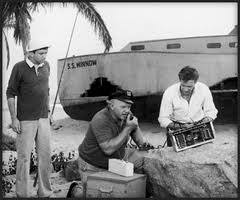
Throughout the infamous Gilligan’s Island television series of the 60’s and similar to artists in the art world, the misfit character Gilligan, played by Bob Denver, often suffers from harsh critical rejection and abusive judgment in multiple forms. Despite Gilligan’s genuine creative efforts, he often succumbs to public scrutiny, private and collective judgment and verbal ridicule in front of the S.S. Minnow crew members with someone finally uttering the critical shunning line, “Oh Gilligan, you’ve done it again!” This exclusionary and repetitive “done it again” refrain, created and produced by the late Sherwood Schwartz, and running for four seasons, placed Gilligan’s Island on the mediated forefront of the American visual culture scene.


How many times have viewers witnessed the ostracizing Skipper roll his eyes and do a double take at the first mate, and sadomasochistically whip his captains hat on Gilligan’s head? The naïve Gilligan waif takes the abuse with a grain of salt, shrugs it off, and simply turns the other cheek, meanwhile staying the course in his artistic naval “duty” and asking for more. Parallel to snobbish art critics, selective curators, pompous collectors, and/or sharkish gallerists, the varied response of the snooty Castaways allows Gilligan to either move up or move down the artistic gate keeping totem pole with acceptance or denial of entry. This traditional, conservative “either/or” positioning of the collective gatekeepers/Castaways blocks both Gilligan and the Castaways from their potential artistic rescue. If the critical Castaways moved to an “and/or” acceptance positioning, they would then self realize the present moment and find the folk artist Gilligan and his creative talents of high worth. The Castaways lack of an “and/or” acceptance position physically and emotionally blocks their return to civilization.


The semi-blind Castaways, akin to often closeted critics, curators, collectors and/or gallery owners are unaware of the creative talent so close in their midst. Gilligan is the quintessential artistic and creative fuck up! To the anonymous tourist and island passerby, Gilligan is nothing more than a low valued, uncreative servant and untalented Dock Boy. Yet, like Edison and Einstein, each creative and inventive failure leads Gilligan to the next inventive and resourceful artistic success. Every episode of Gilligan’s Island is artistically staged as a continuous chance at and creative choice for both individual and collective survival. With the most goofy, kooky and ingenious ways, Gilligan primarily helps, hinders and finally halts the possible Castaways rescue. Whether in the hut, on the beach, near the lagoon, or up the coconut tree, Gilligan is the shape shifting creative portal to the future potential rescue of the cast.


As the first mate and creative misfit, Gilligan sits on the lonely bow, in the cockpit, and at the stern of the possible vessel to the Castaways liberation. To a certain degree, Gilligan the artist represents a positive, survivalist figure escaping the pressures of daily life thru his canvas and mediums. Think Gauguin, think Doig. The island, jungle, beach, wind, water, waves, storms and ocean all develop into a grand blank canvas for the artist Gilligan to mold, shape and form in any creative manner he sees fit. The islands natural biological habitat and geographic canvas become an aesthetic stage for the creative misfit to visually explore, discover, investigate and diagnose.


Comparable to the painter in a flow state at one with their canvas, Gilligan loves to be in nature and at one with the island/jungle/ocean. The more he is in harmony with natural canvas, the further his past and present becomes a mere temporary memory magnified via the transformative creative process itself. His consummate artistic duties are to be a creative producer, to be creatively prepared for anything--whether real or imagined, and also to be an artistic collaborator sharing his eccentric creative talents with the others so that he and the others can be transported, released and/or escape the torment of the island. There is a cute scoutishness to artistic Gilligan, unconditionally helping the others, inventing innocent learning projects, adding new artistic badges to his portfolio, and always being resourcefully prepared. Gilligan’s creativity must be ready to deploy at any moment—as the successful creative escape to the grand curatorial and museological mainland, led and fostered primarily by him for the sake of the others, can happen when the Castaways least expect it.


With a sensitive fairness doctrine, Gilligan, the former President of the Eighth Grade Camera Club, impartially deploys his creativity equally amongst his fellow Castaways. Each individual Gilligan’s Island character needs Gilligan in a slightly different manner, uses and abuses him to their satisfaction, and symbolizes several simultaneous individual and collective social codes, norms and/or tropes. The Skipper represents power, control and authority; the Professor reflects knowledge, information and wisdom; the Howells illuminate capitalism, excess, marriage and naïve trophy housewife; Ginger symbolizes the sexual seductress, deceptive beauty, and fertility; and direct from the Winfield General Store, the coconut cream pie herself, Mary Ann, signifies the organic seed, wholesomeness and domesticity.


Gilligan himself dresses in red Jersey shirt, white bucket hat, bell-bottomed light blue denim pants and seafaring attire reflecting a genuine do-gooder paperboy patriot. (1) Though anti-Vietnam sentiment prevailed at the time, the character Gilligan represents a special anti war, Hollywoodish commentary on the “helpful American.” Like the boys in Nam, he drops by, he messes up the place, and he leaves. Gilligan’s role is often helpful and thoughtful at first, then rejected by those in need when all hell breaks loose. But unlike a Republican bulldozer-of-a-government that thinks might-makes-right no matter what collateral damage occurs, Gilligan is able to quickly reframe, take the high road, apologize and makes amends on the spot. The artist misfit apology system thrives under his powerful critical rejecters/Castaways, by reworking, rebuilding and recombining past artistic goofahs into “ah-ha” moments and creative learning experiences that eventually lead to artistic survival/success.


Gilligan the creative must often choose between the multiple islander codes and symbols—which in turn puts him at duplicit odds with the other Castaways. The collective and individual creative conflict that ensues often confuses Gilligan in the final choices that he is forced to generate. Like the artist at odds with society, Gilligan must choose to create from his soul, heart and mind in order to be at one with both his internal artistic needs, and yet externally set himself both apart from the community, and conversely partner with this community at the same time. Will it be Ginger or Mary Ann?, the Skipper or Professor?, Thurston or Lovie?, the stranded Japanese sailor, the Jungle Boy, or the ape in the cave? Creative participation and artistic choice is often at extreme odds with traditional museological strategies, institutional and academic gate keeping, sanitized curatorial perfectionism, Meeseian community aesthetic norms, and watered-down social artistic codes.


The Castaways continuously project on to Gilligan numerous shape shifting roles: lost son, brother never had, slave/worker, technical assistant, sex symbol, boyfriend, and hero. It is through the psychological projection by the various Castaways own social needs and mental pain that Gilligan is lifted to another creative level. Despite their often disregard, disrespect, and disassociation for him, the others are codependent with Gilligan and in severe need of him to achieve and relinquish their own painful survival quest. Similarly, the codependent curator needs the lost artist and his/her art objects to fulfill the exhibitionary pursuits, museological expeditions, and institutionalized careers. In this regard—by creatively helping the Castaways/gatekeepers, Gilligan sets both himself and the others free. Gilligan is potential savior, liberator, and redeemer, and at the same time acting as rebel, jailer, oddball, and nonconformist. The honest Gilligan folk artist lives in a creator-savior/survivor-destroyer paradox.


The artist savior/survivor paradox plays out on the insular island habitat and archipelago environment as a grand, closeted artist studio ecosystem. The island studio converts into a psychological jail and temporary purgatory—where the Castaways must perform assorted Hollywood skits and novel duties in order to be released from the island asylum. The creative misfit Gilligan holds multiple keys to the jail/studio door. He can let the monkeys in or out of their cage. He can mix, pour, distribute and spill the coconut drinks. He lights the beach bonfire to freedom or douses it with beach sand and ocean water. He designs, builds and sabotages the bamboo life raft. The other Castaways/curatorial characters must paradoxically both love and hate the artistic misfit at the same time. With their museological acceptance of him as creative savior, the fellow Castaways are released of their pain and abandon their fear of the past, present island danger, and potential rescue.


The life that the Castaways are creating on the island is not a bad one. They are continuously challenged in the now and accepting the present moment—but they are also forever living in the duality of past and future—wanting and longing dearly to return the safety/freedom/future of the mainland civilization. The so-called civil mainland represents a dreamlike, Westernized artistic vantage point—with its Ozian capitalism, false perfectionism, and monarchial rules of art law and creative order. Yet, the Castaways are creating a community and collective that functions very well—even within a purgatorial paradise--why would they want to leave the Kansastic island? Individually and collectively the Castaways have a problem of letting go of the potential rescue because they bring to the island so much physical, emotional, and psychological baggage. Similar to the unsurrendered Dorothy, their stressors of everyday mainland life are brought with them on the S.S. Minnow via the turbulent ocean storm to the paradise—personal, political and social problems, items and things they can do without—but addictively long for in order to fulfill their codependency.


The Castaways/gatekeepers are socially, mentally, and physically trapped by their collective and individual past. Why would anyone bring trunks of clothing, furniture, and unnecessary bling on a short ‘three hour tour?” The excursion/three hour tour is a brief revelatory and representative glimpse into our own biology, longer life and livelihood. We humans bring “stuff” along with us where ever we go. And wherever we go—there we are: naked with our baggage. On the canvas of Gilligan’s Island, some of the baggage bubbles to the surface and washes up on shore, some is swept downstream, some sets adrift out to sea, some sinks in the quick-sand mud bath, and some floats to find the safety of the lagoon or mainland safe harbor.

Analogously, art historians, gallerists, curators, and critics all follow art historical, curatorial and museological behavior baggage systems that have been socially and professionally formed over a relatively short period of time (the last 2000 years), and that have created, circulated and disseminated our present day visual presentation systems into the collective social fabric. These visual presentation systems have been structured for and with certain types of individual and collective professional behaviors that follow social, art historical, curatorial, and museological norms and codes, and they project and distribute their past art historical, curatorial and museological baggage, behaviors, and codes onto the next crop of aesthetic gatekeepers, academic art instructors, art historians and critics, visual culture producers and artistic clientele.


It is the First Mates job (albeit an extremely difficult one) to explore, diagnosis, and reframe this Castaway baggage for a positive aesthetic use in the creative journey for artistic rescue. Parallel to the common artist—this job is the never ending creative journey to produce, to be seen, to be chosen and to be included in that next great popular exhibition—the Whitney, the Venice B, the Documenta. The Castaways potential rescue equals that penultimate career point—the satisfaction of fame and success by the jury of your artistic, critical, and curatorial peers. For 99.9 percent of artists that rescue, whether temporary or sustained on the cover of Artforum, will never come. Conversely, that which washes ashore brings forth the new adventure, and sparks the creative impetus for the next chance to climb the gate of the artistic rescue/survival totem.


Both Gilligan and the episodic random island visitors often upset and disrupt the Castaways when presenting this personal baggage back into their own laps. An example of this blowback is when a real artist named Dubov finds his way to the island and paints a “portrait” of Ginger. After viewing the completed painting and seeing herself reflected in the artists mirror, it is no wonder Ginger gets upset—as the Gauguinish Dubov portrays her the way she actually is—as a lovely abstract monster and “real beauty.” Similar mirrored behavior situations occur when Mary Ann and Gilligan’s favorite band the Mosquitoes (Bingo, Bango, Bongo and Irving) arrive; the Russian Cosmonauts wash ashore; or when Gilligan helps Lord Beaseley find the rare Pussycat Swallowtail. The creative disruptions, much like mirrored individual failure, becomes a clear part of the collective Castaways success and brings a new canvas, new artistic beginnings, and a closer glimpse of the artistic rescue.

Eventually, thru all the collective adventures and creative episodes, the unconditional Gilligan achieves non-confined oneness via creating transformational opportunities and enlightened progress for both himself and the other Castaways/gatekeepers. His non-local oneness occurs because he considers that which we formerly considered inconceivable as now to be considerably conceivable. Gilligan is particle and wave. Gilligan is multiple interference waves. Gilligan is implicate and explicate. Gilligan is light and dark and gray matter. Gilligan is a broken holographic plate with memory of the whole. Gilligan is creative resonance and artistic momentum.

We love, like, and hate the creative misfit Gilligan for both bringing forth his/our simple fears and for sharing his/our quirky courage to overcome them. Despite his lack of recognition, his being ignored, his ideas not listened to, or the fact that the critical, curatorial, and gallerist Castaways choose to “like” or use him when it is only in their interest—the brave creative Gilligan still does not placate the powerful art rejection system. In his own insecure and vulnerable manner, Gilligan is the consummate secure artist and confident visual culture producer.


Content in his own primitiveness, Gilligan does not seek career nor aesthetic recognition. The waif doesn’t follow artistic, museum or curatorial trends. To do so would be unprimitive. Everything the Dock Boy creates is new, from scratch and original. No Warhol Mass-Produced here, nor Duchampian Readymades on the quiet island. No prebuilt, rectangular Fredrix stretchers, no archival Liquitex acrylics, no monarchial golden framing devices. No false high status that capitulates and capitalizes from the art market apparati (i.e.: Hurst diamond skulls at auction). The Dock Boy Gilligan rather, offers an innocent and organic free exchange model in his art methods, mediums, and madness. With his aesthetic service sector/tourism job, Dock Boy/ Gilligan is a Vogelesque, giving-style collector that offers artistic dividends to the patronic others rather than building an egocentric museum/island to himself.


It is in this gentle humanitarian art exchange that the traditional museological Castaways and their collective fear Gilligan as an “outsider” and find him humorous. After all, he is feminist, green thinking, D.I.Y. and anti Big Box. He is a misfit who does not belong. Gilligan is anti perfectionistic, which does not go over well with museological Boards of Trustees and their corporate curatorial systems. Gilligan, the sustainable Dock Boy, is the antithesis to traditional art conservation and preservation models so coveted by Western museum systems and capitalistic New York gallery platforms. The messy naval waif is the unwashed “hair out of place” that is not understood in the perfectionist curatorial white cube space, thus annoyingly sparking the new artistic conversation on the island.

With his second-life Northern Spark river journey on the S.S. Megalops Riverboat, Dock Boy/Personal Gilligan seeks out the many Mississippi tributaries as multiple sources of creative energy and renewal. Along with Works Progress, and his new sidekick Admiral Andy, the ever popular broad-beard, each changing twist and turn in the Mighty Miss becomes a challenging seed to a new path in his creative life. Gilligan is able to choose whichever path and tributary he wants--upstream or downstream, port or starboard--often leading to new found transformational creative outcomes and participatory artistic opportunities. Similar to the S.S. Minnow excursions, the Admiral and the Dock Boy take people on artistic boat rides for a one and a half hour tour. The adventurous paddleboat tours are fun, engaging, and empowering. The assertive artist Gilligan and his faded denim slacks love to dance onboard sharing the new nautical transformation experience.


The performative Dock Boy/Personal Gilligan dances to a new coevolving beat with the paddleboat collaborators during the Northern Spark festival. He greets and presents new viewers/Castaways with a welcoming lei, he helps the virgin riverboat riders walk over the entrance bridge of transformation, and he hugs and thanks patrons and recycles their leis upon exit. Onboard the S.S. Megalops Gilligan is a nomadic Candidean shape shifter, roaming exchanger, background listener, answering navigational questions, teaching bowline knots, throwing ratlines and sheets, docking and undocking, flag creator and waver, doing Carol Merrill with Megalopic posters, and sharing the soft “Junior/The Bigendered Megaloptic Asian Carp.” The happy Dock Boy/Personal Gilligan dances because he intuitively knows that “this is all there is” and that his Megaloptic journey on the Mississippi is the “best of all worlds.” (2) The ambitious naval waif creatively dances since he is self aware in knowing the transformative concept that for the one who continues, artistic failure becomes impossible.

Credits:
1. 1. Thanks to my creative and costume conscious cousin Mary Anna Culligan, Costumer & Dyer, Minneapolis Children’s Theatre Company, Minneapolis, MN.

2. 2. Voltaire, Candide, et.al.

Images:
All downloaded from generous fan clubs, stock photo and Internet sites.

Thanks, pete
xoxox

Thursday, February 10, 2011

Artist Daddy-Mom List of Top 13 Process Helper Products of the Year

Artist Daddy-Mom!

List of  Top 13 Artist Daddy-Mom Process Helper Products of the Year.

Thank you Lynda!
There is a myth that artists are notorious for hiding there art, ideas and information--so as to not sabotage their career or so that it won't be stolen. This may true in the past--but there has risen in this false-fear culture a need to share so that we may all survive--whether emotionally, physically or financially.  Both WD-40 and KY Jelly can make everyones lives a tad bit more slippery and juicy in multiple ways.  The following Blist combines open thoughts of items that just might make the average Artist Daddy-Mom's daily grind a little easier. 
The Artist Daddy-Mom having a brief parenting moment!
As an actively engaged artist, painter, father, visual culture producer, school volunteer,  gallery curator, neighbor and worker bee I am constantly struggling to be more centered, balanced, empowered and productive.   With having to wear so many hats, we all could easily add to this list of helpers in numerous arenas.  Whether technical, medical or social--we all have nifty niches that ease our foible and frantic Artist Daddy-Mom lives--and knowing just when to use the cordless screwdriver might save time, money and energy.  Consider this list the start of an ongoing conversation-- one that allows Artist Daddy-Mom's to be more in tune with the present moment  during the multiple, daily,  art producing and  parenting juggling acts.  Imagine the artists Paul Klee, Leon Golub, Joseph Beuys, Kara Walker, Lynda Benglis and James Turrell  were all one gentle Artist Daddy-Mom.

Bags, Bags, Bags.
  1. Tylenol Meltaways ==For those tempermental kiddy melt downs, tantrums, headaches, and crabbiness between 3-5:30 p.m.  Will ease your child's pain quickly and preemptively strikes your own meltdown.   I only wish these came in larger quantities and wider variety of  flavors.
  2. Generic or Ziplock Snack Bags==For lunches, packing for trips, keeping treats, organizing doll shoes, delivering money to school, DIYprojects, hardwares, nuts/bolts, recycled art thingies, medicine, travel pouches, leaf collections, etc.  Wash them and reuse them.  Recycle when done.
  3. Banana Cinnamon Pancakes==Home Made every Saturday.  Use up those spotted bananas, eggs, skim milk and add your own ingredients and toppings. Freeze extra pancakes and use as Frisbees later.  As a creative toss up, the kids love them at dinner time, too.
  4. Water Parks Slides/Swimming Pools==Allow yourself to break free and let go from the tormenting pains of real life by screaming on the top of your lungs several times down one of the wild rides with names like Eagles Nest, Barnstormer, etc  When I was stressed, anxiety and fear driven at the start of my divorce—these exhilarating rides worked wonders in a very masculine-Neanderthal-self-cleansing sort of way.  And I enjoyed in-the-moment fun with the kids at the same time.
  5. In Car DVD/Video Player==Artist Daddy-Mom's best friend on long trips. Memorize all the cool lines from Kung Foo Panda, Sponge Bob, or Tinker Bell over and over again. Kid’s stop fighting and shut up ASAP!  The quiet time in the car is my artistic idea generator time in overdrive. Often listening to what the kids are viewing can be a humbling creative spark.
  6. 7/1, 10/1 or 14/1 Scraper Tool==Mr. Life Saver for painting, refinishing, window repair, and DIY home and studio projects. Keep several types and styles on hand and in different parts of home/studio/garage.  Metal, not plastic; the folding style often collapses--so choose wisely.
  7. Don't forget the Old Bay Seasoning!
  8. 6 Packs of Socks/Tshirts/Undies==Hanes, J.C.Penny, Fleet Farm, etc. As the old become rags, a few bucks goes along way.  Reuse the old grundies for painting, car washing, work rags and clothes for Barbie dolls and  G.I.Joe’s.  They also make great forts or theatrical sets and backdrops for the Barbies and kids puppet shows. 
  9. Sloppy Joe Mix/Fajita-Taco Mix==Burger variations are a Dads and kids best friend. Done in less than 15 minutes and kids love’m.  Organic and grass fed meat and poultries are widely available. We have fun making faces with the accompanying  condiments and  accoutrement's.
  10. Milk Crates==Fuck high design. Organize on the speedy and cheap, baby! Makes fast, practical shelves, storage units, carry totes, craft organizers, recycling, art bins, etc.  It's okay to look like you are still in college.  My former partner hated these--but imaginative Einstein knew different.  Don't waist money on those cheesy shelving units at Ikea, Target, Pottery Barn or Elements--they're generally poorly made and weaken or collapse within a few years.
  11. Scoop Shovel==Massive volumes of snow, leaves, Polly Pockets, and Lego's cleaned up ASAP.  I keep a miniature scoop shovel in my car just in case I go off the road and get stuck in the snowy ditch out in the boon docks.  Or worse, when the snowplow buries your parked car with your new date--you can impress her with your mechanical preparation. 
  12. Roof Rake==Always an adrenaline rush, prevent those Ice Damns and get top exercise. This is a must for a MN homeowner. Modify your roof rake with colorful tape like a hockey stick to prevent slipping.  Grunt the Jimmy Connors and John McEnroe "aaaaaghhghgh!" with each pull, and in an hour you'll be wanting a long hot bath with a generous cocktail.  When I do this I imagine myself pulling the ink on a gigantic ink press or paint across extremely large canvases.
  13. Oscar Mayer Lunchables==Okay--I am Pro brown bagging it.  But, this is So EASY!  You SAVE Time! Especially on days when you are super stressed and rushed. And it’s all recyclable.  My children have a great school recycling plan so the waste all comes home.  This waste in turn is put into my Minneapolis recycling bins--and I get a financial credit on my utility bill.
  14. Daily Shower Spray== Less grime, less time cleaning. In fact—the shower can be cleaned less often.  Until I recently moved I did not know how great I had it.  My former homes old spotless shower that I sprayed every other day is no match for my new homes moldy one with broken moldy grout.  I'd rather watch Star Trek reruns than clean the boogers and pubic hairs in shower.  
    Delirious Drone/Green-Detail,   Pete Driessen © 2009,  108 x 144 Inches, Acrylic Mediums on Unstretched Canvas.  
    Here's to a less stressful, more peaceful, highly productive, and successfully creative Artist Daddy-Mom year!  Cheers, pete